How to Buy Your First Wholesale Bale on BalePick
A step-by-step guide to buying second-hand clothing in bulk on BalePick, from choosing the right lot and reading grades to checking walkthrough videos and calculating your real cost per piece.

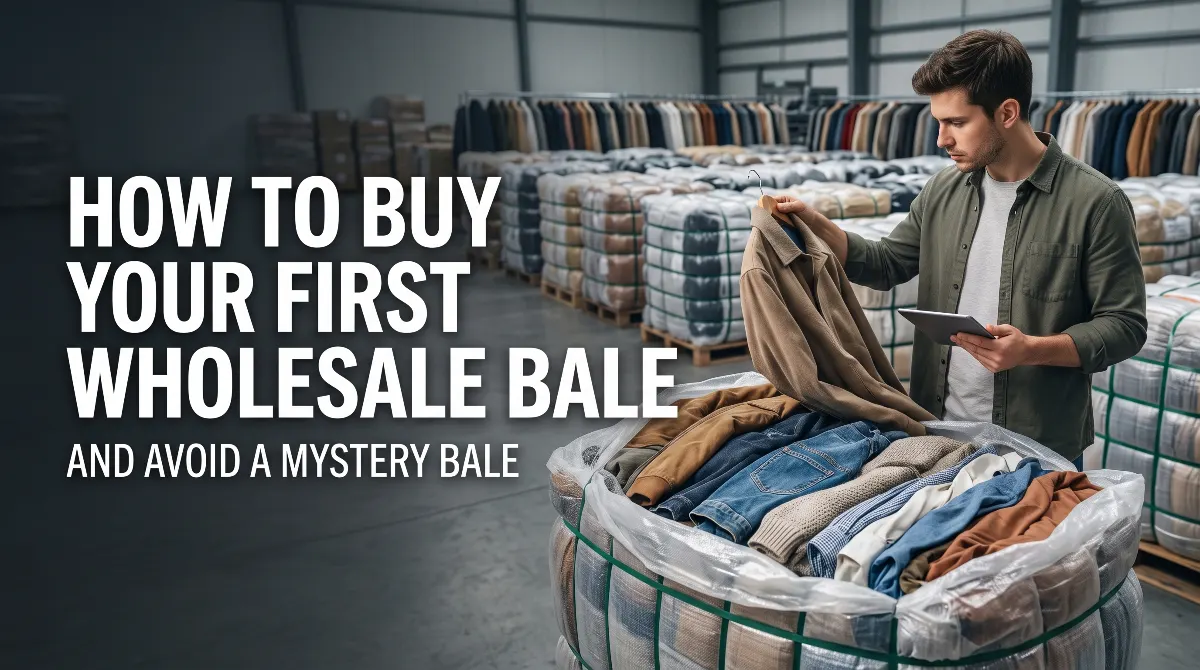
Every reseller has a mystery-bale story: the bundle that looked great in one photo and arrived as a pile of stained, off-season stock nobody wanted. Buying second-hand clothing in bulk doesn't have to be a gamble. You just need to know what to look at before you pay and how to work out what each piece really costs you.
This guide walks you through buying your first wholesale bale on BalePick, step by step.
1. Decide what your customers actually buy
Start from your sell-through, not from what looks good in a listing. Before you browse, write down three things:
- The categories that sell fastest for you. Jackets, denim, knitwear, kids' clothing, whatever leaves your rail or your online shop first.
- The sizes your customers ask for. A bale in the wrong sizes is slow stock, however good the brands are.
- The season you're buying for. Order for when the stock will arrive and be listed, not for today's weather.
2. Know the two kinds of listing
Every listing on BalePick is one of two kinds, and they work differently.
- Exact lot. One specific lot, sold whole. What you see in the photos and the walkthrough video is exactly what you get.
- Representative listing. A sample of a larger stock. You choose how many pieces you want, and the pieces you receive match the declared category, brands, size range and grade, but they aren't the exact pieces in the photos.
If you're buying for the first time from a supplier, an exact lot removes most of the guesswork. A representative listing is a better fit once you trust a supplier and want to choose your own quantity.
3. Read the grade like a buyer
The grade tells you the condition you're paying for:
- Grade A: excellent, with little to no visible wear.
- Grade B: good, with light wear.
- Grade C: worn, with visible flaws or repairs needed.
Mixed lots are graded A/B, B/C or A/B/C. A mixed grade isn't necessarily a bad thing. It can offer good value if the price reflects it and you have a plan for the lower-grade pieces. Each product page has a condition guide, and the grade is checked again at our hub when your order is inspected.
4. Watch the whole walkthrough video
Every listing on BalePick has a walkthrough video of the actual stock. It's required before a listing can go live. Photos show the best pieces; the video shows the lot.
When you watch it, look for:
- Consistency. Do the pieces look like the grade on the listing all the way through?
- The mix. Are the brands, styles and colours the ones the title promises?
- Condition details. Pause on close-ups: collars, cuffs, zips, underarms and hems are where wear shows first.
- Sizes. Check that what you can see matches the size range on the listing.
Photos sell a bale. The video tells you what's in it.
5. Check the supplier, not just the stock
On every listing, you can see who is selling it, where they ship from, their rating and reviews, and how many days they take to dispatch. Open the supplier's storefront to see the rest of their stock and their portfolio.
If something isn't clear, ask. Use Message on the product page. The conversation stays on BalePick, so it's covered by the same protection as your order.
6. Work out your real cost per piece
The listing price is per piece. What matters for your margin is the landed cost, which is what each piece costs you once it's in your hands:
- the price of the goods,
- the shipping for your route,
- the estimated import duty.
On BalePick, all three are shown as separate lines at checkout, in US dollars, before you pay, and buyers pay no platform fee. Divide the total by the number of pieces and you have your real cost per piece. That's the number to compare with what each piece will sell for.
7. Negotiate, or ask for exactly what you need
You don't have to buy at the listed price.
- Make an offer from any product page. The supplier can accept, decline or counter, and an accepted price is held for you for 48 hours.
- Request a handpick when you want a supplier to put together a custom bundle by category, brand, size range, grade and budget.
- Post on Demand Hub when you can't find what you need. Describe the items, quantities and grades, and verified suppliers send you quotes with photos and a walkthrough video.
8. Know what happens after you pay
Your payment is held by BalePick. The supplier isn't paid yet. The supplier sends your order to a BalePick hub, where we inspect it against the listing and record photos and video in a QC report before it ships on to you. You can follow every step on your order page.
When it arrives, check it within 5 days. If something is wrong, report it from your order page with photos or video. The supplier has 3 days to respond, and if you can't agree, BalePick decides based on the listing, the QC report and the evidence from both sides.
Your first-bale checklist
- I know which categories, sizes and season I'm buying for.
- I've chosen an exact lot or a representative listing on purpose.
- The grade matches my plan for selling every piece.
- I've watched the whole walkthrough video.
- I've checked the supplier's rating, country and dispatch time.
- I've worked out my landed cost per piece.
- I know I have 5 days after delivery to report a problem.
Ready to find your first bale? Browse the marketplace, or post what you need on Demand Hub and let suppliers come to you.